
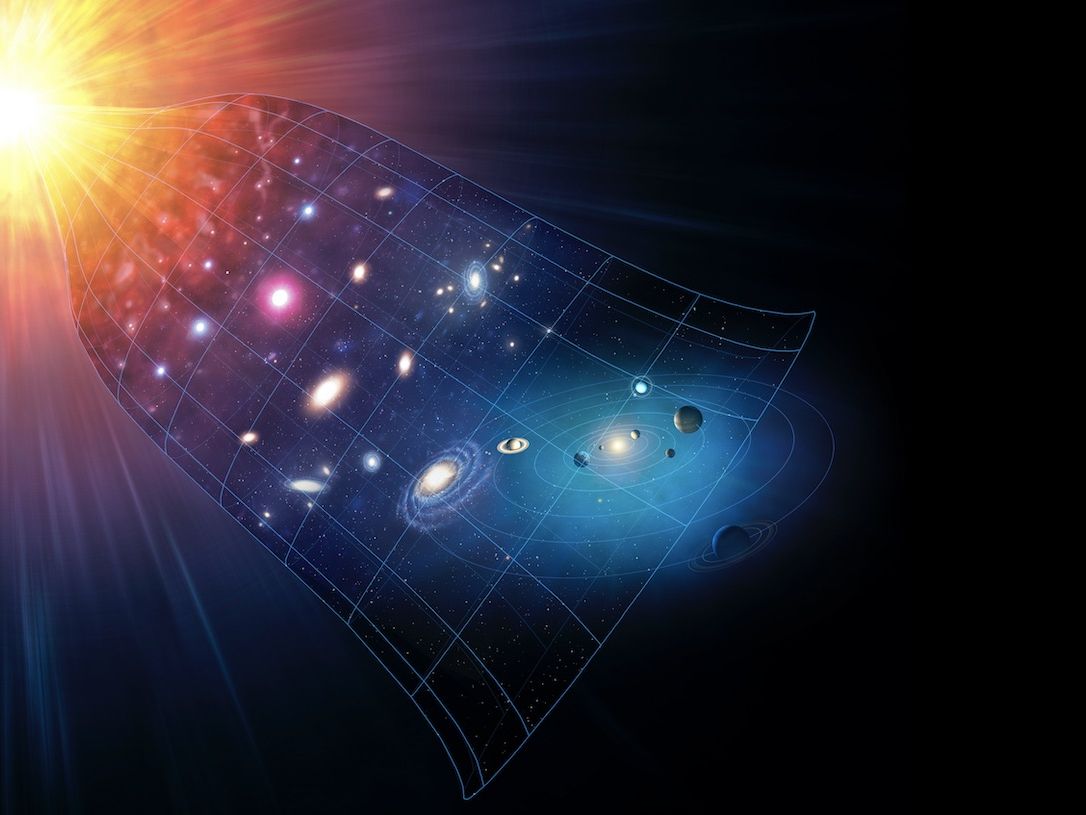

Astronomers say the universe is still expanding at an accelerating rate, reinforcing the modern view that cosmic growth is being driven by a mysterious force known as dark energy. A new analysis by researchers using updated astronomical data found no convincing sign that the long-accepted picture is breaking down. Instead, the results support the idea that the universe’s expansion is not slowing under gravity alone, but continuing to speed up over time.
This question is one of the biggest in cosmology because it goes to the heart of how the universe evolves. For much of the 20th century, scientists assumed that although the universe was expanding, gravity from matter would gradually slow that expansion. That changed in the late 1990s, when observations of distant exploding stars, known as Type Ia supernovae, showed that the universe’s expansion had actually begun speeding up billions of years ago. That discovery led to the idea of dark energy, an unknown component thought to make up most of the cosmos and act as a kind of repulsive pressure on large scales. The new research is consistent with that framework rather than with recent suggestions that acceleration might be weakening or reversing.
The updated findings matter because some recent studies had raised doubts about whether dark energy behaves as a simple constant force. The new work used broader and improved datasets to test those claims and found that the standard picture still holds up. In other words, while researchers continue debating the details of dark energy, the basic conclusion that the universe’s expansion is accelerating remains intact.
That does not mean scientists fully understand what is causing the acceleration. Dark energy remains one of the deepest mysteries in physics. Researchers do not know whether it is truly a constant property of space itself, as in Einstein’s cosmological constant, or something more dynamic that changes over time. But the latest results suggest that any new theory still has to explain an accelerating universe, because the acceleration itself has not disappeared from the evidence.
The question is also tied to the fate of the universe. If cosmic acceleration continues indefinitely, galaxies will move farther apart, the night sky will grow emptier over immense spans of time, and the universe could end in a cold, diffuse state where stars burn out and matter becomes increasingly isolated. If dark energy were to weaken or change, the long-term future could look different. That is why even small refinements in these measurements matter so much: they shape not just our picture of the past, but our understanding of the universe’s ultimate destiny.
Researchers are expected to keep testing the issue with new telescopes and surveys that can map galaxies, supernovae and cosmic structure with much greater precision. Projects now underway should help determine whether dark energy is truly constant or whether subtle variations may emerge in the data. For now, though, the simplest answer remains the strongest one: the universe is still expanding faster and faster.
The de new study does not solve the mystery of dark energy, but it does strengthen one of modern cosmology’s most important conclusions. The universe’s expansion is still accelerating, and whatever dark energy is, it continues to shape the cosmos on the largest possible scale.