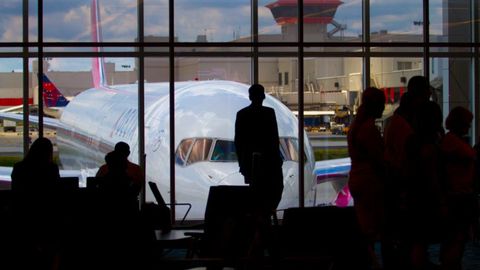

Hundreds of airline passengers experienced significant travel disruptions at Raleigh-Durham International Airport in North Carolina after a damaged fiber-optic cable caused a major communications failure, forcing the Federal Aviation Administration (FAA) to temporarily restrict flight operations.
The incident, which occurred on Monday, October 12, 2026, resulted in widespread delays, cancellations, and diverted flights, highlighting the vulnerability of critical aviation infrastructure to unexpected technical failures.
By Monday afternoon, airport officials reported 212 delayed flights and nine cancellations, with disruptions continuing throughout the evening.
The incident affected travelers heading to domestic and international destinations, leaving passengers scrambling to rearrange flights, find alternative transportation, and avoid missing important commitments.
According to airport officials, the disruption began when an FAA contractor accidentally cut a fiber-optic communications line near the airport’s air traffic control tower while performing plumbing repairs.
The damaged cable interrupted essential communications and automation systems used to coordinate aircraft movements.
As a safety precaution, the FAA issued a ground stop, temporarily preventing certain flights from departing for Raleigh-Durham.
The restrictions began shortly after 10 a.m. and expanded as technicians worked to identify and repair the problem.
At various points, the FAA limited the number of aircraft permitted to arrive at the airport, creating congestion and delays across airline schedules.
Although technicians eventually restored the affected equipment, the disruption lasted for much of the day.
By Monday evening, flight-tracking data cited by local media indicated that approximately 266 flights had been delayed and 47 canceled.
For many travelers, the technical failure quickly became a logistical nightmare.
One passenger, Bill Hunt of Cary, North Carolina, was preparing to travel to Rome, Italy, for an important business meeting scheduled for the following morning.
When his original flight was canceled, Hunt had to find another way to reach Europe.
He eventually secured a seat on a flight departing from Charlotte but faced an additional challenge: getting there.
Because flights between Raleigh-Durham and Charlotte were also affected, Hunt arranged ground transportation to reach the alternative airport.
Other passengers experienced less severe disruptions.
John Haney, who was traveling to Cincinnati, reported a relatively manageable delay compared with travelers facing hours of uncertainty.
Some arriving aircraft were diverted to other airports, forcing passengers to wait for further instructions or make alternative travel arrangements.
The situation demonstrated how a single technical problem can affect travelers far beyond the airport where it originates.
The incident has raised broader questions about the resilience of the United States’ air traffic control infrastructure.
Modern airports depend on interconnected communications networks, automated systems, and reliable data connections to manage aircraft safely.
When one essential component fails, the consequences can spread rapidly through airline operations.
The Raleigh-Durham outage illustrates the importance of protecting critical communications equipment and maintaining effective backup systems.
Although officials identified the damaged fiber-optic cable as the immediate cause, the incident also highlights the potential consequences of construction or maintenance activities near sensitive aviation infrastructure.
It remains unclear whether additional safeguards could have prevented the disruption or reduced its duration.
FAA restrictions were lifted Monday evening after the affected equipment was restored.
However, the consequences extended into Tuesday, when more than 60 additional flight delays were reported.
For airlines, such disruptions can create scheduling complications involving aircraft availability, flight crews, connecting passengers, and airport operations.
For travelers, they can result in unexpected expenses, missed meetings, and considerable uncertainty.
The incident serves as a reminder that airport reliability depends not only on aircraft and airline performance but also on the infrastructure supporting air traffic control.
As American airports manage increasingly complex travel networks, the Raleigh-Durham disruption underscores the importance of maintaining resilient communications systems capable of preventing isolated technical failures from becoming widespread transportation emergencies.