
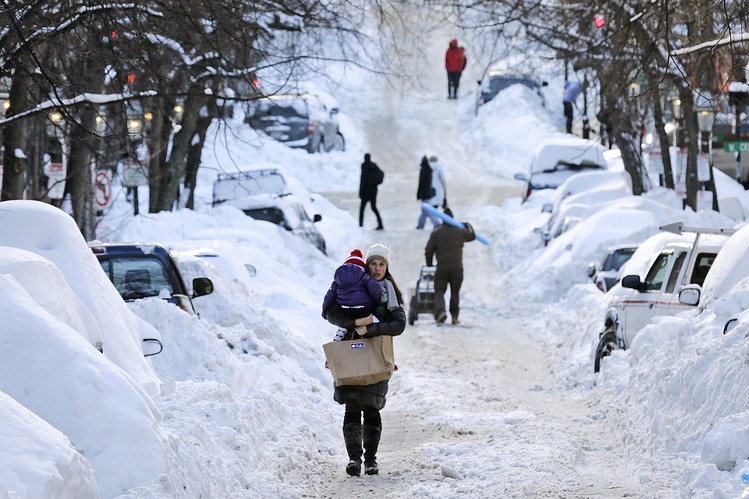

A powerful winter storm slammed the U.S. Northeast, trapping millions indoors from Maryland to Maine as blizzard warnings, road travel bans, and widespread closures reshaped daily life across the region. The heavy snow is generating damaging winds that knocked out power, immobilized transportation, and forced governments and institutions to shut down.
Meteorologists said the storm had the ingredients for a major snowfall event: a “Goldilocks” temperature range that produced wet, heavy snow—dense enough to pile up quickly and, when combined with strong winds, create dangerous conditions and widespread disruption. The National Weather Service characterized the system as a classic “bomb cyclone/nor’easter” off the Northeast coast—an intensifying storm whose pressure drops rapidly in a 24-hour period, a hallmark of some of the region’s most intense winter events.
Snow totals were significant and, in some places, record-breaking. Central Park recorded 19 inches (48 cm), while Warwick, Rhode Island, exceeded 3 feet (91 cm). Winds were equally intense: the strongest gust recorded was 83 mph (133 kph) in Nantucket, with hurricane-force gusts reported across Cape Cod. Those winds worsened visibility and increased the risk of downed trees and extended outages.
The storm’s impact rippled through air travel and public services. New York, Philadelphia, other cities, and several states declared emergencies. Flight disruptions mounted quickly: more than 5,600 flights in and out of the United States were canceled Monday, with another 2,000 flights scheduled for Tuesday grounded; nearly 2,500 flights were delayed, with the worst effects concentrated around airports in New York, New Jersey, and Boston.
Some airports essentially shut down. Rhode Island’s T.F. Green International Airport temporarily ended all operations, and the Weather Service reported it received nearly 38 inches (96.5 cm) of snow—breaking a record set in 1978. Public transit also slowed or halted in places, and delivery services pulled back; DoorDash suspended deliveries in New York City overnight into Monday.
Power outages spread as the heavy, wet snow and wind stressed trees and lines. More than 450,000 utility customers nationwide were still without electricity Monday evening. In the hardest-hit metro areas, schools closed widely—New York City and Boston canceled in-person classes for Monday, while Philadelphia shifted to online learning, and some suburbs planned a second day of closures. Even major cultural landmarks and events were affected, including closures at institutions like New York’s Museum of Modern Art and cancellations of Broadway shows.