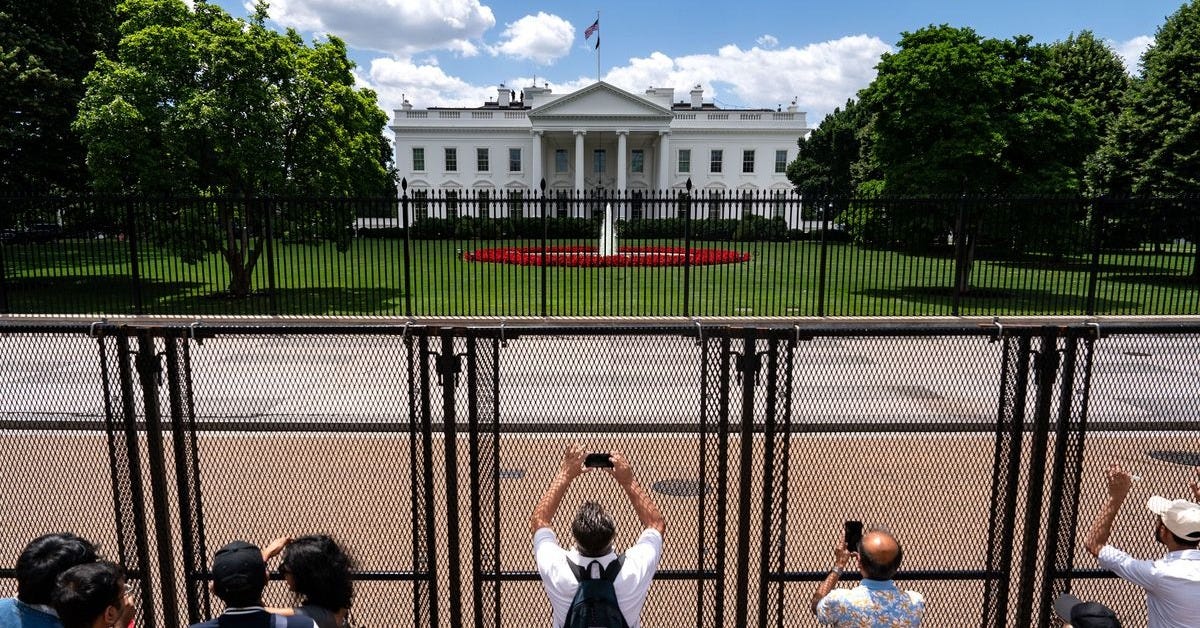

The Trump administration is considering installing permanent fencing at both ends of Pennsylvania Avenue outside the White House, giving the Secret Service the ability to block pedestrian access whenever officials identify a security threat. The proposal would place gates near the intersections of Pennsylvania Avenue NW with 15th and 17th streets, according to people familiar with the internal discussions. The area directly north of the White House is currently open to pedestrians but closed to ordinary vehicle traffic.
Under the plan, the new gates could remain open during normal conditions, allowing visitors to continue walking along Pennsylvania Avenue and viewing the White House. During emergencies, demonstrations or periods of elevated security concern, however, the Secret Service and White House could close the entrances and prevent the public from entering the section in front of the executive mansion. Officials currently rely on temporary barriers and personnel to close the avenue when necessary. Permanent fencing would make those restrictions faster and easier to enforce.
The administration is reportedly considering reusing fencing materials already deployed for major events and security operations rather than purchasing an entirely new barrier system. It remains unclear how much construction would be required, what the fences would look like, how high they would be or how much the project would cost. The proposal has not yet been finalized, and projects affecting the historic White House grounds generally require review by federal planning and preservation bodies.
Supporters of the proposal say the changes would strengthen presidential security at a time of heightened concern about political violence and threats against public officials. The Secret Service has repeatedly sought larger security buffers around the White House, and previous incidents involving people breaching or attempting to breach the complex have led to taller perimeter fencing and additional restrictions. Officials argue that permanent gates would be more reliable and efficient than repeatedly installing temporary barriers.
However, earlier administrations reportedly resisted similar recommendations because of concerns that permanent barriers would make the White House feel increasingly isolated from the public. Pennsylvania Avenue and nearby Lafayette Square are among Washington’s most symbolic public spaces, regularly used by tourists, demonstrators and residents. Critics worry that creating more permanent barriers could gradually transform the area surrounding the “people’s house” into a secured zone with limited public access.
The Pennsylvania Avenue plan is connected to a separate proposal to install fencing on the north and south sides of Lafayette Square, the park across from the White House. Those gates would similarly allow officials to close the park when they believe security conditions require it. Taken together, the plans could give the administration much greater control over public movement throughout the area north of the White House.
The proposal also arrives amid broader changes Trump has pursued around the White House complex, including alterations to gardens, interiors and surrounding grounds. Those projects have generated debate over presidential security, historic preservation, public access and the extent to which any administration should permanently reshape one of the country’s most recognizable civic spaces.
Overall, the fencing plan represents a difficult balance between protecting the president and preserving public access. Permanent gates could help the Secret Service respond more quickly to threats, but they would also provide the government with a new mechanism for closing one of Washington’s most important public spaces. The ultimate impact will depend on the final design, the approval process and how frequently officials use the gates to restrict pedestrians.