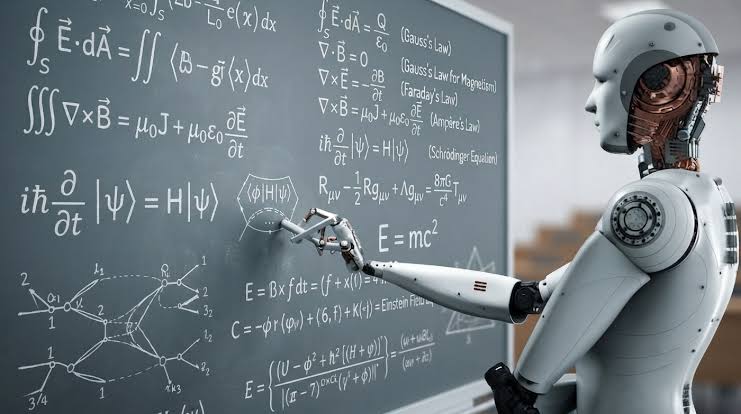

Artificial intelligence is advancing so rapidly in mathematics that leading researchers are beginning to confront a question once confined largely to science fiction: what happens to mathematicians when AI systems can independently solve important research problems? The debate intensified in August when prominent mathematicians gathered at OpenAI’s San Francisco offices to discuss how their profession could evolve if machines eventually become better than humans at mathematical discovery.
The concern goes far beyond AI becoming better at calculations. Computers have performed arithmetic faster than humans for decades. What is changing is AI’s growing ability to engage with the creative side of mathematics: developing proofs, exploring conjectures, connecting ideas and working on problems that previously required highly trained researchers.
Recent progress has surprised even experts. Advanced AI systems have demonstrated increasingly sophisticated mathematical reasoning and have begun contributing to genuine research questions rather than merely solving textbook exercises. This raises the possibility that mathematics could become one of the first highly intellectual academic professions to experience significant automation at its research frontier.
Yet AI remains far from a perfect mathematician. Harvard mathematician Melanie Matchett Wood, who participated in the OpenAI meeting, highlighted an important weakness: leading models can struggle to recognize which portions of a mathematical argument are genuinely difficult. They may devote excessive explanation to straightforward steps while moving too quickly through the crucial reasoning.
That limitation illustrates an important distinction between finding an answer and communicating mathematical understanding. Mathematics is not simply about producing correct proofs. Researchers must determine why a result matters, identify connections with existing knowledge, explain difficult ideas clearly and decide which questions are worth investigating.
The arrival of increasingly capable AI is therefore creating several possible futures.
One possibility is that mathematics begins to resemble modern software engineering. AI systems could allow hundreds of researchers to collaborate on extremely complicated problems, automating portions of proofs while humans coordinate larger intellectual projects.
Another possibility is that mathematics becomes more similar to experimental physics. Instead of relying primarily on individual human reasoning, researchers could use enormous AI systems as scientific instruments—much as physicists use particle accelerators—to explore mathematical territory beyond what an individual person could investigate.
A more radical scenario would transform mathematicians into something resembling curators of machine discoveries. AI systems might generate thousands of new theorems, proofs and mathematical relationships, while humans decide which discoveries are interesting, meaningful or useful.
That possibility worries some researchers. University of Toronto mathematician Daniel Litt has discussed a pessimistic future in which humans become mathematically “disempowered”: machines continue producing increasingly advanced mathematics while people gradually lose the ability to understand the frontier of their own discipline. Litt has emphasized, however, that this represents only one possible outcome rather than an inevitable future.
OpenAI mathematician and research scientist Sébastien Bubeck takes a more optimistic perspective. He argues that AI could instead provide mathematicians with extraordinarily powerful tools that expand what humans can accomplish. The objective, in his view, should be ensuring that technological progress continues benefiting mathematicians themselves rather than reducing them to spectators.
The transformation also presents unresolved questions about academic credit and standards. If an AI generates a proof, who should receive recognition? How should researchers verify enormous machine-generated arguments? And if humans cannot fully understand an AI discovery, should it still count as mathematical knowledge?
There are not yet established norms for answering these questions. Mathematics has traditionally been built around human-readable proofs that other experts can inspect, understand and reproduce. AI could challenge that tradition by generating discoveries faster than researchers can interpret them.
The deeper issue is therefore not simply whether AI will outperform mathematicians. It is whether artificial intelligence will replace mathematical thinking or amplify it.
If humans remain responsible for choosing meaningful questions, interpreting discoveries and developing deeper understanding, AI could become one of the most powerful tools mathematics has ever acquired. But if machines eventually discover and prove results that humans can no longer meaningfully follow, mathematics could become one of the first intellectual disciplines forced to redefine what human expertise itself is for.