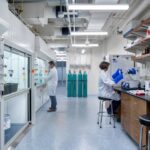

Massachusetts’ powerful biotechnology industry is showing signs of a significant comeback in 2026 after several difficult years marked by layoffs, falling investment, empty laboratory buildings and uncertainty over federal scientific funding. New data from the Massachusetts Biotechnology Council, or MassBio, suggests capital is returning rapidly, even though employment has not yet recovered from the downturn.
The damage from the slump was substantial. Massachusetts’ biopharma workforce declined 3.1% in 2025, falling by roughly 3,600 employees to 113,503. It was the first annual employment decline in more than two decades of MassBio tracking the industry. Research-and-development jobs were particularly affected, declining 3.9%, while many laboratory buildings constructed during the pandemic-era biotech boom remained vacant.
The downturn followed an extraordinary expansion during the early pandemic. Investors poured money into biotechnology companies, startups multiplied and developers constructed millions of square feet of new laboratory space around Boston and Cambridge. But higher interest rates, disappointing clinical results, difficult public markets and declining venture investment eventually brought that expansion to an abrupt halt.
Now, several important indicators are moving in the opposite direction.
Massachusetts biotech companies raised $3.45 billion in venture capital during the first half of 2026, a 25% increase compared with the same period in 2025 and the strongest first-half performance since 2023. Massachusetts companies captured roughly a quarter of all U.S. biotech venture funding during the period, demonstrating that the state remains one of the country’s dominant life-sciences centers.
Public markets are also reopening. Eight Massachusetts biotechnology companies completed initial public offerings during the first half of 2026, matching the combined number of IPOs from all of 2024 and 2025. Those companies represented nearly two-thirds of U.S. biotech IPOs during the six-month period.
Acquisitions provide another encouraging signal. Eleven Massachusetts companies were acquired for a reported $18 billion, compared with $7.6 billion in disclosed acquisition value during the comparable period a year earlier. Successful acquisitions can return capital to investors, who may then finance another generation of biotechnology startups.
Large pharmaceutical companies have also begun expanding locally. Sanofi, Vertex, Pfizer, Alnylam, AbbVie and Biogen added Massachusetts workers during 2026, while Eli Lilly more than doubled its local workforce from approximately 540 to 1,423 employees.
But the recovery remains uneven.
Investment is increasingly concentrated in companies that have already demonstrated promising scientific results. The average Series A financing round climbed to approximately $79.6 million, while average seed funding fell to just $4.65 million. That suggests investors are willing to make large bets on more established biotechnology companies while remaining cautious about the earliest and riskiest startups.
Employment also continues to lag behind investment. Although biomanufacturing added 238 positions in 2025, overall industry employment declined. Companies appear reluctant to rebuild their workforces immediately after several years of restructuring and layoffs.
Federal research funding presents another uncertainty. Massachusetts received 9.3% of all National Institutes of Health funding in 2025, an extraordinary share for a relatively small state, but the number of NIH awards declined 6.2%. Because universities and academic laboratories provide discoveries that frequently become commercial biotechnology companies, weaker federal research support could eventually damage the startup pipeline.
Massachusetts also faces intensifying international competition, particularly from China. MassBio reports that China’s drug-development pipeline expanded 36.2% over the past year, surpassing Europe’s for the first time.
The picture emerging in 2026 is therefore one of recovery rather than a completed comeback. Money is returning, IPOs are increasing, acquisitions are accelerating and major pharmaceutical companies are hiring again. But thousands of jobs lost during the downturn have not yet returned, early-stage startups remain under financial pressure and significant laboratory space remains empty.
Massachusetts nevertheless retains an extraordinary concentration of scientists, universities, pharmaceutical companies and investors. If the renewed flow of capital eventually translates into sustained hiring and new drug development, 2026 could mark the year America’s most important biotech hub finally emerged from its post-pandemic slump and began a new cycle of growth.