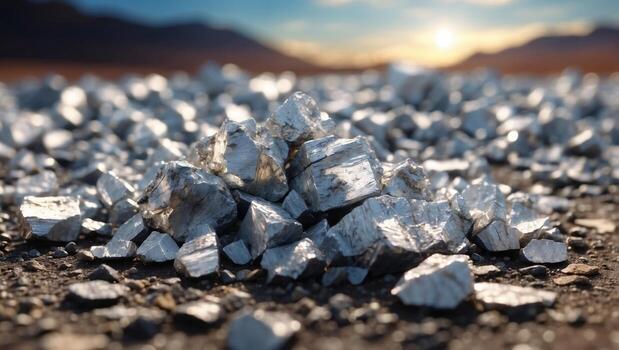

Arkansas is emerging as a potentially important player in America’s effort to build a domestic lithium industry and reduce its dependence on China for one of the most strategically important minerals of the energy and technology economy. Beneath southern Arkansas lies the Smackover Formation, a geological formation containing lithium-rich underground brines that companies and state officials believe could support significant U.S. production of battery-grade lithium.
Lithium has become increasingly important because it is a fundamental component of rechargeable batteries used in electric vehicles, consumer electronics and large-scale energy storage. Securing supplies has consequently become an economic and national-security priority. China maintains a particularly powerful position in global lithium processing and the wider battery supply chain, leaving Washington concerned about the vulnerability created by relying heavily on foreign-controlled supplies.
Arkansas believes its combination of geology, existing industrial infrastructure and decades of experience handling underground brines gives it an unusual advantage. The Smackover region already supports a major bromine industry, meaning workers and companies have extensive experience extracting brine and reinjecting it underground. Developers hope that expertise can be adapted to lithium without requiring the enormous open-pit mines traditionally associated with mineral extraction.
One of the most advanced projects is the South West Arkansas Project, being developed by Smackover Lithium, a partnership between Standard Lithium and Norwegian energy company Equinor. Standard Lithium owns 55% of the venture and Equinor holds 45%. The project covers approximately 30,000 acres of brine leases near Magnolia and Lewisville and is targeting initial production capacity of about 22,500 metric tons of battery-quality lithium carbonate annually.
Instead of relying on conventional evaporation ponds, the project intends to use direct lithium extraction, or DLE. The technology processes lithium-rich brine, selectively removes the lithium and returns much of the remaining brine underground. Advocates believe this approach could reduce the physical footprint and some environmental impacts associated with traditional lithium production while allowing extraction in areas with established oil, gas and chemical infrastructure.
The project has already passed several important milestones. In May, the U.S. Department of Energy completed its environmental review and issued a Finding of No Significant Impact. Developers have also awarded major engineering and construction contracts as they move toward a final investment decision. Commercial production is currently targeted for the latter part of the decade.
Finding customers has been another crucial step. In March, Smackover Lithium signed a binding agreement with commodities trader Trafigura covering 8,000 metric tons of lithium carbonate annually for 10 years once commercial production begins. The agreement provides a future customer for a substantial portion of the project’s planned output and can help support financing.
Federal support is also playing a role. The Department of Energy has considered cost-shared funding for the Arkansas development as part of Washington’s broader strategy to increase domestic production of critical minerals. The government sees projects like this as important not only for electric vehicles but also for industrial resilience and America’s ability to compete technologically with China.
Nevertheless, building a competitive American lithium industry will not be simple. New projects require enormous capital investments, sophisticated processing technology, regulatory approvals and customers willing to sign long-term agreements. Lithium prices can also fluctuate dramatically, potentially making billion-dollar projects more difficult to finance when global supply exceeds demand.
Environmental questions remain important as well. Across the United States, proposed lithium developments have encountered concerns about water consumption and local ecosystems. Arkansas developers argue that the Smackover Formation has advantages over lithium regions in the drought-prone American West, including established brine-reinjection infrastructure and lower water stress.
Arkansas represents a potentially significant experiment in rebuilding America’s critical-minerals supply chain. If DLE technology works economically at commercial scale, the state could transform its long history of underground brine production into a new lithium industry. The larger objective extends far beyond Arkansas: creating enough domestic mining, extraction and processing capacity to make the United States less vulnerable to China’s dominance of the materials powering batteries and the next generation of technology.