
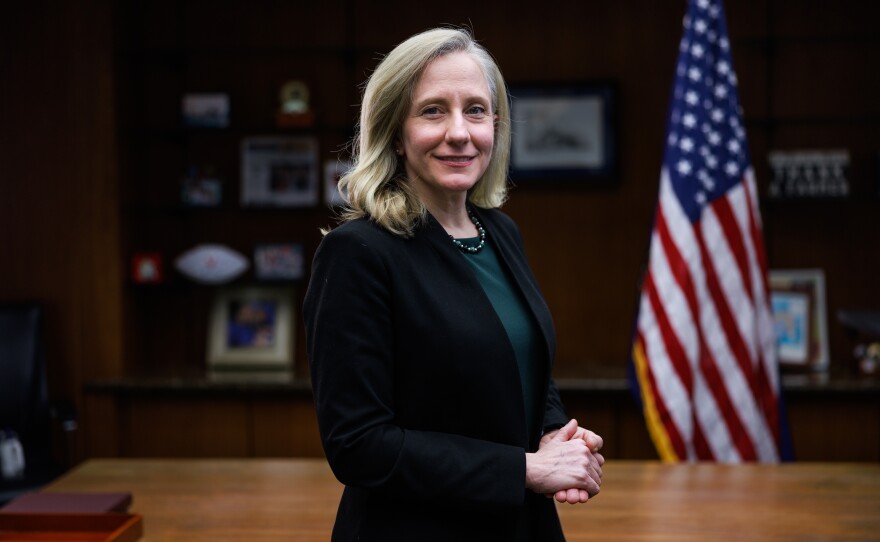

Virginia’s newly elected governor, Abigail Spanberger, will deliver the Democratic response to President Trump’s upcoming State of the Union address, giving Democrats a high-profile chance to rebut the White House’s message on a night when the president commands the biggest audience. Party leaders framed her selection as a strategic choice: Spanberger won statewide by a double-digit margin on an affordability-and-costs message, and Democrats want to elevate that theme as they try to regain control of both chambers of Congress in the 2026 midterms.
Senate Democratic leader Chuck Schumer said Spanberger would lay out “a clear path forward” centered on lowering everyday costs, protecting health care, and defending core freedoms—an attempt to contrast a kitchen-table agenda with Trump’s agenda and style. The response is scheduled to air immediately after Trump’s address to a joint session of Congress on Tuesday, February 24, 2026, according to an announcement from House Democratic leader Hakeem Jeffries and Schumer.
The assignment is notoriously difficult. The president’s speech offers a long, choreographed platform to set the national narrative, while the opposing party gets only a short slot—often without a live audience—making it harder to generate momentum or viral moments for the “right” reasons. Trump’s first joint address of his second term ran an unusually long 1 hour 40 minutes, while last year’s Democratic response (delivered by Elissa Slotkin) lasted a bit over 10 minutes.
Democrats are also widening their response beyond a single speech. Leaders said California Sen. Alex Padilla will deliver the Spanish-language rebuttal, and some lawmakers plan to skip Trump’s address entirely in favor of alternative programming, including a “People’s State of the Union” rally on the National Mall. Some Democratic members have been urged to attend in “silent defiance,” while others want to boycott to avoid normalizing Trump’s agenda and to deny him the spectacle of a divided opposition in the chamber.
Spanberger’s biography is part of the pitch. A former Central Intelligence Agency case officer and three-term member of the U.S. House of Representatives, she has built a reputation as a pragmatic, security-focused Democrat who has sometimes worked across party lines—qualities party leaders see as an electoral asset. Since taking office, she has signaled she will work with the administration where possible, but she has also taken pointed shots at the White House, including criticism tied to cuts and disruption in the civil service—an especially sensitive issue in Virginia, which has a large federal workforce.
Overall, the selection underscores Democrats’ midterm strategy: spotlight affordability, defend health care and civil-service stability, and use a “new face with a governing win” to counter Trump’s singular ability to dominate a national political stage.