
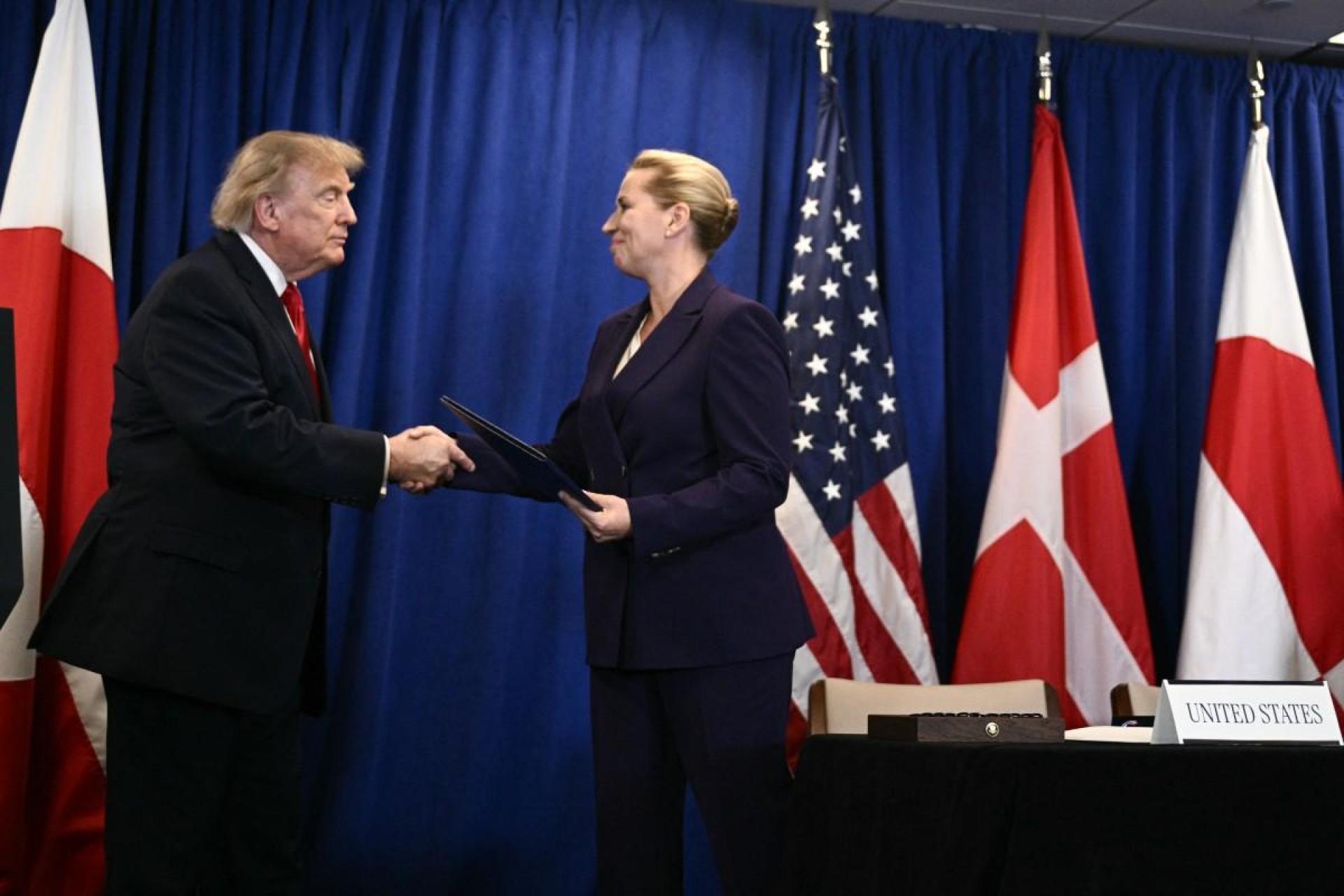

The United States, Denmark and Greenland have signed a major new security agreement that significantly expands the American military presence on Greenland while leaving sovereignty over the strategically important Arctic territory unchanged.
The agreement represents an effort to resolve months of diplomatic tension generated by President Donald Trump’s repeated demands for greater American control over Greenland.
Rather than transferring ownership or sovereignty to Washington, the deal expands U.S. military access and strengthens NATO’s role in defending the Arctic and North Atlantic.
One of its most important provisions allows the United States to establish two additional military bases in Greenland.
The first will be located at Narsarsuaq in southern Greenland, where the United States operated the Bluie West One air base during and after World War II. The second will be established at Mestersvig on Greenland’s east coast, an isolated military outpost currently associated with Denmark’s Sirius Dog Sled Patrol.
Washington will also be permitted to expand Pituffik Space Base, the only active American military installation currently operating in Greenland.
The agreement gives American military aircraft and vessels broad access across Greenland, including rights involving flights, landings and underwater operations in Greenlandic territorial waters.
However, the document does not specify how many additional American troops will ultimately be deployed or provide a detailed timetable for constructing the new facilities.
The expanded presence reflects Greenland’s increasingly important position in global security.
Located between North America and Europe and bordering the Arctic, Greenland occupies a strategically valuable position for missile detection, space surveillance and monitoring military activity across the northern hemisphere.
The United States has become particularly concerned about growing Russian and Chinese activity in the Arctic.
Climate change is simultaneously making the region more accessible, potentially opening new shipping routes and increasing international interest in Greenland’s substantial mineral resources.
Trump has argued that these developments make Greenland essential to U.S. national security.
He previously called for the United States to acquire the island and at times declined to rule out economic or military pressure to achieve that objective, triggering strong opposition in both Denmark and Greenland.
The new agreement takes a different approach.
Instead of annexation, Washington receives substantially greater military access while Denmark retains sovereignty and Greenland preserves its right to self-determination.
Greenland remains a self-governing territory within the Kingdom of Denmark.
Trump has characterized the agreement as giving the United States permanent authority to meet its security requirements in Greenland. Danish and Greenlandic leaders, however, have emphasized that the agreement does not transfer sovereignty to Washington.
The distinction is important.
The United States receives expanded security rights, but Greenland does not become American territory.
The agreement also places Arctic security more firmly within the broader NATO framework. Denmark has emphasized that defending Greenland should be considered part of the alliance’s collective responsibility rather than simply a bilateral issue between Copenhagen and Washington.
Another important element involves foreign military and economic influence.
The arrangement is designed to prevent hostile powers from establishing military positions in Greenland and to restrict certain sensitive investments that could create national-security concerns.
The agreement therefore represents a compromise among three competing priorities.
Washington obtains a significantly stronger military position in one of the world’s most strategically important regions. Denmark avoids surrendering sovereignty over Greenland. And Greenland’s government retains its formal right to determine the island’s political future.
For NATO, meanwhile, the arrangement strengthens the alliance’s northern defenses at a moment when the Arctic is becoming increasingly important in the strategic competition involving the United States, Russia and China.
The result is a significant change in Arctic security without the territorial transfer Trump once advocated.
America will gain more bases, broader military access and a stronger strategic position in Greenland—but Greenland itself will remain Greenlandic and part of the Danish kingdom unless its people ultimately decide otherwise.