
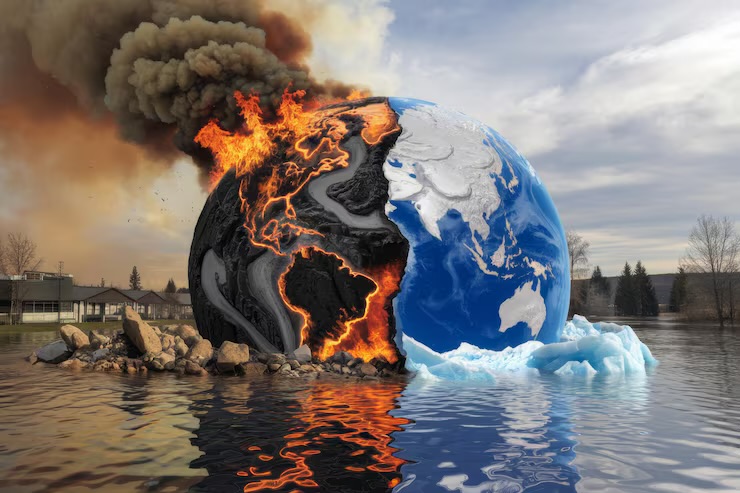

A new United Nations climate report warns that the world is likely entering an even hotter period, with the next five years expected to bring record-breaking temperatures and more dangerous extreme weather. The report from the World Meteorological Organization and the United Kingdom’s Met Office says there is a 91% chance that at least one year between 2026 and 2030 will temporarily exceed the 1.5 degrees Celsius warming threshold set by the Paris climate agreement.
There is an 86% chance that one of the next five years will surpass 2024, currently the hottest year ever recorded. That means the planet is not just warming slowly in the background; it is likely to keep pushing into new territory very soon. The WMO projects that each year through 2030 could average between 1.3C and 1.9C above late-1800s levels, showing how close the world is to repeatedly crossing dangerous temperature lines.
The 1.5C threshold is important because it has become a key global benchmark for climate danger. Passing it for one year does not mean the Paris Agreement has officially failed, since that target is measured over a longer-term average. But temporary breaches still matter. They increase the chances of stronger heat waves, droughts, floods, wildfires, crop losses and damage to ecosystems. Scientists warn that every fraction of a degree makes climate impacts more severe.
One major reason for the expected heat is the likely return of El Niño, a natural warming pattern in the Pacific Ocean that raises global temperatures and disrupts weather around the world. The WMO report suggests a strong El Niño could develop soon and may last into 2028, making 2027 especially likely to break heat records. But scientists stress that El Niño is adding to a deeper human-driven problem: the long-term buildup of greenhouse gases from burning fossil fuels.
The Arctic is expected to warm much faster than the global average. The report projects Arctic winter temperatures could be about 2.8C warmer than the recent average, accelerating the loss of sea ice and snow. That creates a feedback loop because ice normally reflects sunlight, while darker ocean water absorbs more heat. As the Arctic melts, it can speed up global warming and disrupt weather patterns far beyond the polar region.
Other regions face different dangers. The Amazon may become drier, raising the risk of drought and fires in a region that normally helps absorb carbon dioxide. Northern Europe and other high-latitude areas could see wetter conditions, increasing flood risks. These changes show that climate change does not affect all places the same way, but almost every region will face some form of disruption.
Overall, global warming is accelerating into daily reality. The next five years may bring new heat records, more extreme weather and growing pressure on health, food systems and infrastructure. The message from scientists is clear: the world still has choices, but delay is making every future year hotter, more unstable and more expensive.