
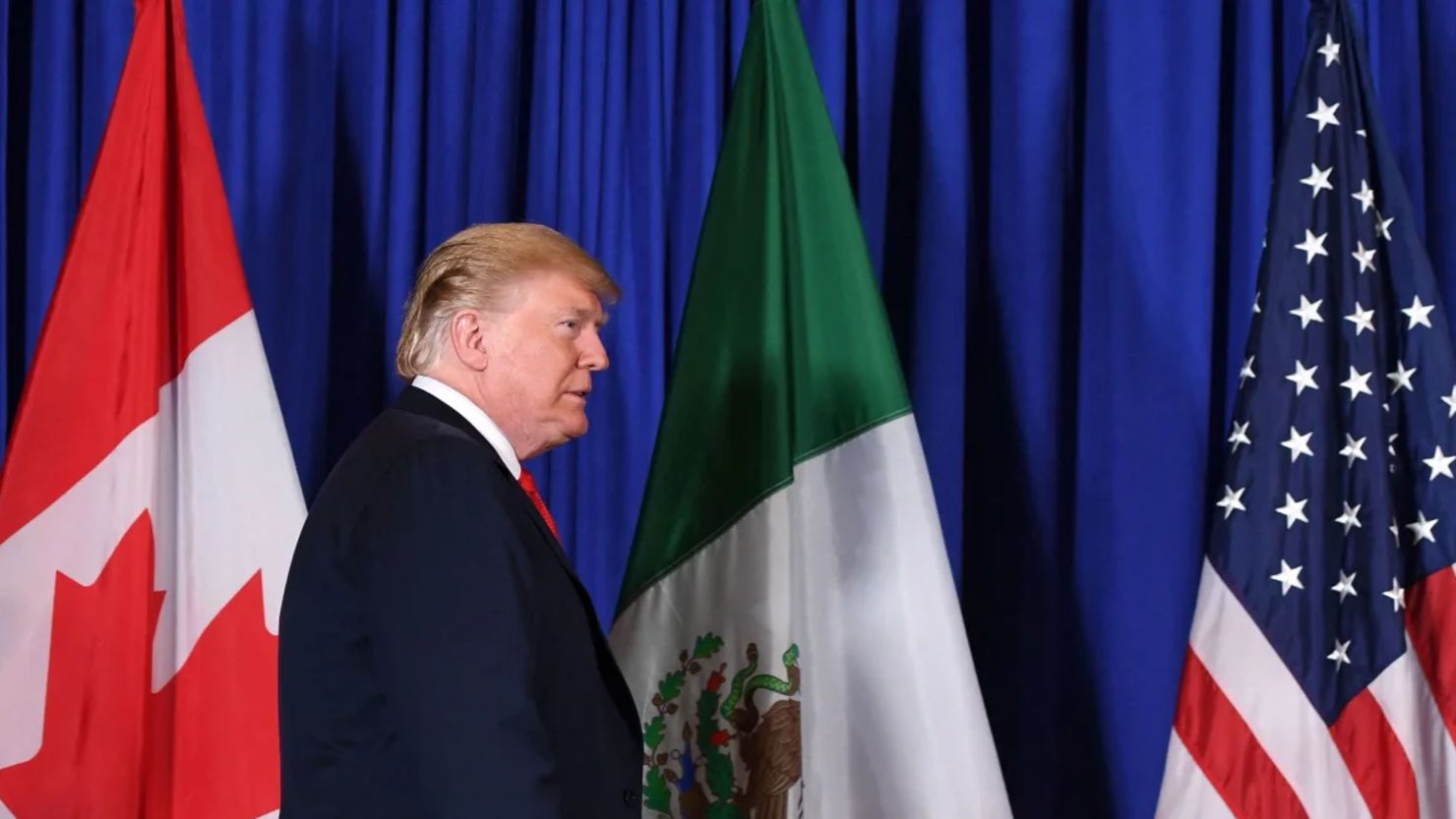

President Donald Trump said the United States might not renew the United States-Mexico-Canada Agreement, raising new uncertainty over the future of North American trade. Trump told reporters he may either let the agreement expire or seek a different deal with Canada and Mexico, citing frustration over U.S. trade deficits and what he views as unfair treatment of the United States.
The USMCA replaced NAFTA in 2020 and is one of the most important trade agreements in the world. It governs commerce among the United States, Mexico and Canada, linking industries such as autos, agriculture, energy, technology, machinery and consumer goods. The pact supports nearly $1.6 trillion in annual trade and underpins a highly integrated North American economy.
The agreement is entering a critical review period. Under its rules, the three countries must decide whether to renew the pact for another term or begin a process that could eventually lead to its expiration. The current deadline requires the countries to renew or start exiting the agreement by July 1. Trump’s comments therefore come at a sensitive moment, when businesses and governments are trying to understand whether North America’s trade framework will remain stable.
Trump’s central complaint is the U.S. goods trade deficit with its neighbors. The United States had a $46 billion goods trade deficit with Canada and a $197 billion deficit with Mexico in 2025. Trump has often treated trade deficits as evidence that the United States is losing economically, even though many economists argue that deficits reflect broader patterns in supply chains, consumption, exchange rates and investment rather than simple unfairness.
For Mexico and Canada, the threat is serious. Mexico is the United States’ top trading partner and sends about 80% of its exports north. Canada sends nearly 70% of its exports to the U.S. Together, the two countries also account for nearly a third of U.S. goods exports. That means a collapse or major weakening of USMCA would hurt all three economies, especially industries that depend on cross-border production.
The auto industry would be especially exposed. Cars and parts often cross borders multiple times before final assembly. If USMCA were weakened or replaced with tariffs, companies could face higher costs, production delays and pressure to reorganize supply chains. Farmers, energy companies and manufacturers could also face uncertainty over market access, rules of origin and dispute settlement.
The Trump administration has already been preparing for difficult negotiations. In May, the U.S. and Mexico had scheduled three rounds of trade talks without Canada, signaling a more fragmented approach than the original trilateral negotiations that created USMCA. Formal talks with Canada had not yet been launched at that time.
Overall, Trump’s warning may be both a negotiating tactic and a genuine threat. By suggesting he could walk away, he increases pressure on Canada and Mexico to offer concessions on agriculture, manufacturing, tariffs and trade balances. But the risk is that uncertainty itself can damage investment and business planning. The future of North American trade now depends on whether Trump uses the USMCA deadline to renegotiate — or to unravel one of the continent’s most important economic agreements.