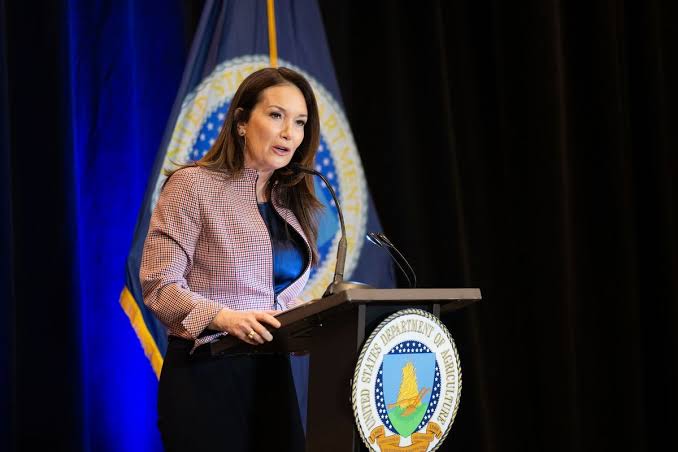

A federal judge has ruled that U.S. Agriculture Secretary Brooke Rollins likely violated the First Amendment by sending religious messages to approximately 100,000 Department of Agriculture employees through her official government email account.
The November 19, 2026, decision represents a significant legal setback for President Donald Trump’s administration and raises important questions about religious freedom, workplace protections and the separation of church and state.
U.S. District Judge Trina Thompson, based in San Francisco, issued a preliminary injunction restricting how Rollins communicates religious messages to federal employees. The ruling followed a lawsuit filed in May by six USDA employees and the National Federation of Federal Employees, a labor union representing approximately 19,000 Agriculture Department workers.
The plaintiffs argued that Rollins used her government position to promote Christianity, creating an environment in which employees with different religious beliefs could feel excluded or pressured.
The court concluded that the challenged communications likely violated the First Amendment’s Establishment Clause, which limits government endorsement or coercion involving religion. The controversy centered on messages distributed by Rollins during several holidays, including Independence Day, Thanksgiving, Christmas and Easter.
The communications included Christian imagery, biblical references and statements presenting Christian beliefs as shared values among department employees.
One Easter message celebrated the resurrection of Jesus Christ and encouraged recipients to embrace Christian hope. The court emphasized that Rollins did not similarly acknowledge holidays associated with other religious traditions.
Judge Thompson expressed particular concern about the secretary’s repeated use of collective language suggesting that all employees shared her beliefs. Because the messages came from the department’s highest-ranking official, workers could reasonably interpret them as expressing an institutional religious preference.
The ruling focused on three central factors: Rollins’ position of authority, her use of official government communication channels and language that could alienate employees who did not share her faith.
The judge observed that federal workers cannot realistically ignore messages from their agency’s leader, particularly when the same email account distributes important administrative information.
Consequently, employees might feel pressure to conceal their religious identities or appear to support their supervisor’s beliefs.
The court determined that such circumstances could create unconstitutional religious coercion. Importantly, the ruling does not prohibit Rollins from practicing Christianity or discussing her beliefs.
She remains free to participate in religious activities, explain the personal importance of her faith and engage in voluntary conversations with interested colleagues.
However, she cannot use her official authority to pressure subordinates into religious participation. She must also respect requests to stop unwanted religious discussions and avoid creating a hostile workplace environment.
These restrictions reflect existing USDA guidance on religious expression. The Agriculture Department strongly criticized the decision, arguing that Rollins was expressing personal religious views rather than compelling employees to participate in religious activities.
Officials described the ruling as an unprecedented restriction on a Cabinet secretary’s freedom of expression. The department indicated that it was evaluating legal options, including a possible appeal.
The administration’s position highlights the tension between protecting individual religious expression and preventing government officials from using public authority to promote particular beliefs.
The case could influence how federal agencies communicate about religion and religious holidays. It also reflects broader disagreements over the role of Christianity in public institutions during Trump’s presidency.
For federal employees, the decision reinforces the principle that workplace protections extend to individuals of every faith and those who practice no religion.