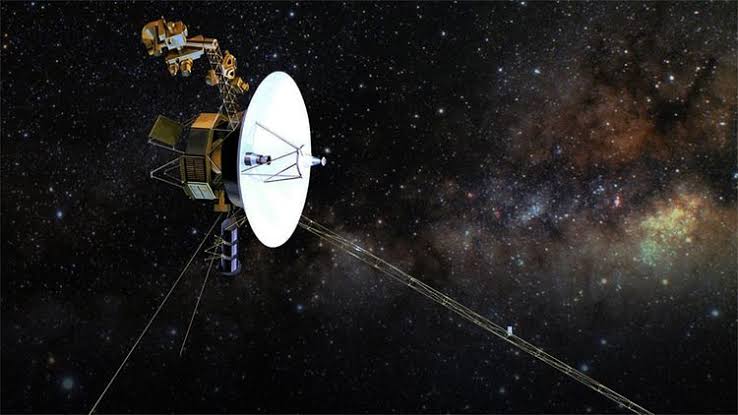

NASA’s Voyager 1 spacecraft is approaching an extraordinary milestone in the history of space exploration: becoming the first human-made object to travel so far from Earth that light itself takes an entire day to reach it.
According to Nature, the spacecraft continues its journey through interstellar space nearly five decades after its launch, despite declining power supplies and the gradual shutdown of scientific instruments. The achievement demonstrates both the remarkable durability of NASA’s engineering and humanity’s expanding ability to explore beyond the solar system.
Voyager 1 launched on September 5, 1977, as part of NASA’s ambitious mission to investigate the outer planets. Originally designed to study Jupiter and Saturn, the spacecraft provided groundbreaking observations of planetary atmospheres, magnetic fields, rings and moons.
Its discoveries included important information about Jupiter’s turbulent atmosphere and Saturn’s complex ring system. After completing its planetary encounters, Voyager 1 continued traveling outward.
In August 2012, it crossed the heliopause, the boundary separating the solar wind’s influence from the surrounding interstellar medium. This made Voyager 1 the first spacecraft to enter interstellar space. A light-day is the distance light travels through space in 24 hours, approximately 25.9 billion kilometers, or 16.1 billion miles.
Reaching this distance from Earth represents an unprecedented achievement for a spacecraft. Radio signals travel at approximately the speed of light, meaning a command transmitted from Earth would require an entire day to reach Voyager 1 at that distance.
A response would take another day to return. Consequently, even a simple exchange between engineers and the spacecraft would require approximately 48 hours.
This communication delay makes troubleshooting increasingly challenging. Voyager 1 relies on radioisotope thermoelectric generators, which produce electricity from heat released by radioactive decay.
Unlike solar panels, these generators can operate at enormous distances from the Sun. However, their electrical output gradually decreases. NASA engineers have responded by shutting down instruments and nonessential systems to conserve power.
Only a small number of scientific instruments remain operational. The spacecraft’s aging electronics, communications equipment and propulsion systems also require careful management. Despite these challenges, Voyager 1 continues transmitting valuable scientific information.
Voyager 1’s scientific mission did not end when it passed the outer planets. Its remaining instruments investigate conditions in the space between stars, including magnetic fields and energetic particles. These measurements help researchers understand how the Sun interacts with the wider galactic environment.
They also provide information about cosmic radiation and the boundary surrounding the Sun’s influence. Such observations cannot be reproduced by spacecraft operating close to Earth. Voyager 1 therefore remains an important source of direct measurements from an environment humanity has barely explored.
Voyager 1 carries a Golden Record containing sounds, images, music and greetings representing life on Earth. Created as a symbolic message for any civilization that might encounter the spacecraft, the record reflects humanity’s desire to communicate across cosmic distances.
Even after Voyager 1 stops functioning, the spacecraft will continue traveling through space. The approaching one-light-day milestone underscores the extraordinary success of a mission originally expected to last only a few years.