
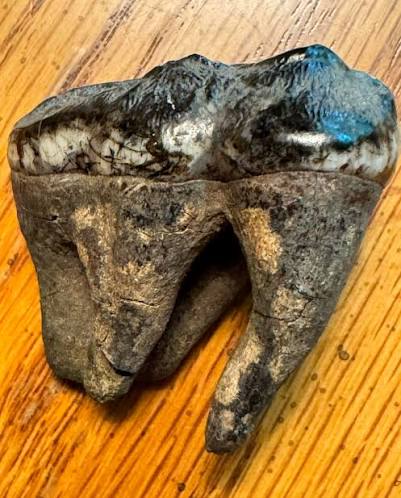

A routine habitat restoration project in California has produced an extraordinary glimpse into North America’s prehistoric past after a scientist discovered an exceptionally well-preserved fossilized tooth belonging to a Pacific mastodon.
The discovery was made by geomorphologist Brigid Lynch while she was working along a wooded creek in a mountainous section of the San Francisco Bay Area. Lynch was participating in a project intended to restore habitat for the threatened California red-legged frog when she noticed something unusual among the rocks in the water.
The object turned out to be a fossilized mastodon molar.
Remarkably, the fossil was not deeply buried or hidden inside a rock formation. It was simply sitting partly submerged in the creek, where the right person happened to notice it.
The tooth was discovered inside a preserve managed by the Midpeninsula Regional Open Space District in San Mateo County. The agency protects more than 70,000 acres of natural land throughout the Santa Cruz Mountains region.
Scientists say the fossil is unusually well preserved.
Measuring approximately 9 inches, or 23 centimeters, long, the tooth retains both its crown and root. Its preservation is so exceptional that scientists can even see the internal root canal.
The specimen belonged to a Pacific mastodon, an extinct elephant-like mammal that once inhabited North America.
Mastodons lived on the continent for millions of years before disappearing roughly 10,000 to 12,000 years ago, around the end of the last Ice Age. Although they resembled modern elephants and mammoths, mastodons represented a distinct evolutionary branch and were adapted largely to forested environments.
Their teeth are particularly recognizable.
Unlike mammoths, whose flatter teeth were suited to grinding grasses, mastodons possessed large molars with pronounced cone-shaped structures that helped them crush branches, leaves and other vegetation.
The newly discovered tooth has now been donated to Stanford University’s Doerr School of Sustainability, where researchers plan to study it more closely.
Scientists hope eventually to determine the fossil’s precise age, which could provide additional information about when mastodons inhabited this particular part of California and what the surrounding environment may have looked like during that period.
Researchers also plan to create a 3D replica of the tooth.
That copy will be provided to the Midpeninsula Regional Open Space District for educational programs and public outreach, allowing visitors to learn about the enormous prehistoric mammals that once occupied landscapes now associated with modern Silicon Valley and the San Francisco Bay Area.
Paleontologists emphasize that mastodon fossils themselves are not necessarily extraordinarily rare. Depending on the region, remains can occasionally emerge as erosion, construction or natural processes expose ancient geological layers.
What makes this discovery especially compelling is its preservation, its location and the circumstances surrounding it.
Lynch was not searching for prehistoric animals.
She was studying the landscape as part of an environmental restoration effort when erosion and chance apparently placed the fossil directly in her path.
The discovery therefore connects two dramatically different periods of California’s natural history.
Thousands of years ago, mastodons moved through landscapes populated by ecosystems very different from those seen today. In 2026, scientists working in the same region are attempting to protect the California red-legged frog, a species facing its own modern survival challenges.
Officials responsible for the preserve see that connection as particularly meaningful.
The mastodon tooth demonstrates that protected landscapes do more than preserve contemporary plants and animals. They can also safeguard geological and paleontological evidence containing information about ecosystems that disappeared thousands of years before modern California existed.
The fossil could ultimately help scientists better understand the distribution of Pacific mastodons, ancient environmental conditions and the natural history of the Bay Area.
But the discovery also carries a broader message.
A project designed to protect one threatened species unexpectedly uncovered evidence of another animal that vanished from the planet thousands of years ago.
The remarkable tooth therefore represents more than an impressive fossil. It is a physical connection between California’s prehistoric past and its modern conservation efforts—and a reminder that protecting natural landscapes can preserve stories stretching far beyond the species living there today.