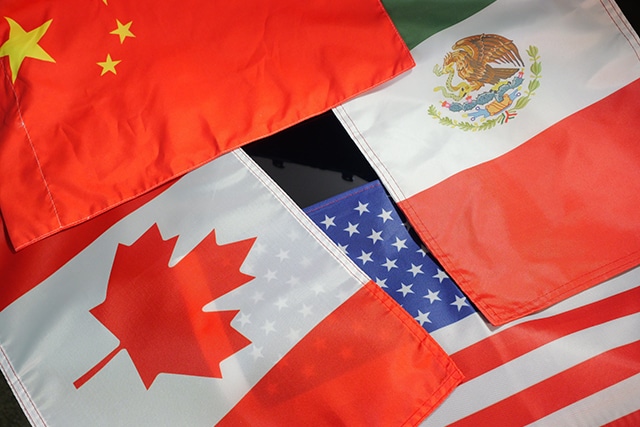

U.S. Democratic senator is urging the Trump administration to tighten the U.S.-Mexico-Canada Agreement (USMCA) to prevent Chinese companies from using Mexico as a manufacturing platform to reach the U.S. market under preferential trade rules. Sen. Ruben Gallego sent a letter to President Donald Trump and U.S. Trade Representative Jamieson Greer calling for a renegotiation that would strengthen protections against what he sees as a looming repeat of the early-2000s “China shock”—when a surge of Chinese imports contributed to heavy disruption in U.S. manufacturing communities.
Gallego’s concern is that Chinese government-supported firms could increasingly build or acquire operations in Mexico, then ship goods north under USMCA benefits, effectively bypassing barriers aimed at China while still undercutting U.S. manufacturers. He argues the agreement’s current structure leaves loopholes that could encourage exactly this “nearshoring-for-tariff-avoidance” model—especially in sectors with intense global overcapacity and aggressive pricing. The senator frames this as both an economic and political risk: if U.S. industrial jobs are hit again, the backlash could be severe, and Washington would have fewer tools to respond quickly.
To close that perceived gap, Gallego called for stricter rules of origin—the provisions that determine how much of a product must be made in North America to qualify for tariff-free treatment. Tougher origin rules would make it harder for products assembled in Mexico with largely Chinese inputs to qualify as “North American.” He also pushed for labor-related changes, including a minimum wage in Mexico’s manufacturing sector, arguing wage disparities can incentivize offshoring and can contribute to economic instability that feeds illegal migration.
The letter also argues that some USMCA labor protections need to be rebuilt and strengthened. Gallego urged the administration to reestablish labor agreements that he says were cut by the Trump administration, and he criticized certain USMCA provisions as insufficient—for example, the requirement that some auto content be made by workers earning at least $16 per hour. In his view, those measures either don’t reach far enough or aren’t structured strongly enough to prevent a surge of low-wage production that still qualifies for preferential market access.
Timing is central. Gallego’s push comes ahead of the scheduled six-year USMCA review, when the U.S., Mexico, and Canada are set to reassess the agreement’s operation and consider changes. Greer is expected to meet with Mexico’s Economy Minister Marcelo Ebrard as part of that process. Gallego’s letter is essentially an attempt to shape the U.S. negotiating position early—before the review becomes a narrow technical exercise and instead turns into a broader re-set around China-linked supply chains.
The USTR has launched a new investigation into unfair trade practices tied to global excess manufacturing capacity—particularly associated with China—suggesting Washington is building multiple policy lanes to address “China-plus-one” production strategies. In that context, Gallego’s message is: if the U.S. wants to protect domestic industry, it can’t focus only on China’s exports from China; it also needs to rewrite the North American rules that may unintentionally invite Chinese production to relocate and re-enter through Mexico.