
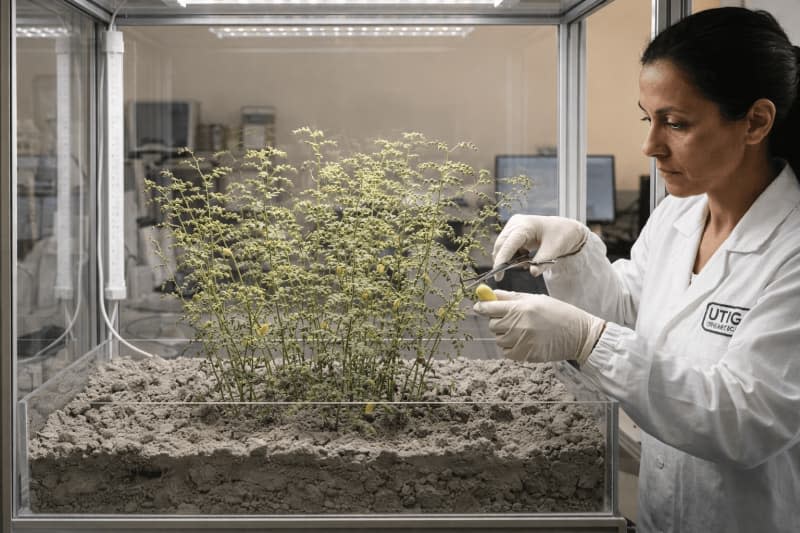

Scientists have taken a practical step toward feeding astronauts on long-duration lunar missions: they successfully grew and harvested chickpeas in a soil mixture made mostly from simulated lunar regolith—the dusty, rocky material that covers the Moon.The experiment was designed to answer a question that becomes urgent as NASA and other space programs move from short visits to sustained presence: if crews stay longer, shipping all food from Earth becomes costly and limiting, so future explorers will need ways to produce at least some fresh, nutritious food locally.
The work was conducted in a climate-controlled growth chamber at Texas A&M University, using a chickpea variety called “Myles.” Researchers chose chickpeas because they are nutrient-dense and high in protein, making them a strong candidate for space diets where calories, storage, and nutrition matter. Instead of trying to grow the plants in pure regolith simulant (which is extremely challenging), the team created blends that paired “moon dirt” with supportive biological inputs.
Two additions were especially important. First, the team mixed the lunar simulant with vermicompost—nutrient-rich material produced when earthworms break down organic waste. Second, they coated seeds with beneficial fungi, specifically arbuscular mycorrhizal fungi, which can form a symbiotic relationship with plant roots. These can improve nutrient uptake and help plants cope with stress, and they may also reduce the amount of metals plants absorb—an important consideration because lunar-like soils can contain high levels of metals that could be problematic for edible crops.
The results were encouraging but also revealed clear limits. Chickpeas could be grown to a harvestable stage when the soil blend contained up to about 75% lunar simulant—but 100% simulant hindered growth, with plants failing to thrive and not producing flowers or harvestable seeds. The “sweet spot” appears to be mixtures where biological inputs and organic matter compensate for regolith’s weaknesses: regolith lacks living microbes and organic nutrients, has challenging chemistry (often high pH), and can have poor structure for holding water.
But the study is not claiming astronauts can start eating lunar-grown chickpeas tomorrow. Researchers are still evaluating food safety and potential toxicity, because lunar simulant is designed to mimic regolith’s physical and chemical properties, including elevated metals. That means the path from “plants can grow” to “food is safe to eat” includes more testing, plus engineering work to adapt the process to real lunar constraints like radiation, reduced gravity, limited water, and tight habitat space.
Still, the experiment is a proof-of-concept for a broader idea: turning regolith into soil with biology. By showing that microbes and compost-like inputs can make “moon dirt” support a real crop, the research supports a future where lunar bases rely on closed-loop systems—recycling organic waste into growing media, using plants to supplement diets, and potentially improving life-support resilience. In short, it’s a small but meaningful step toward sustainable living beyond Earth.