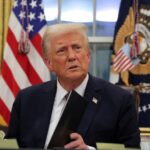
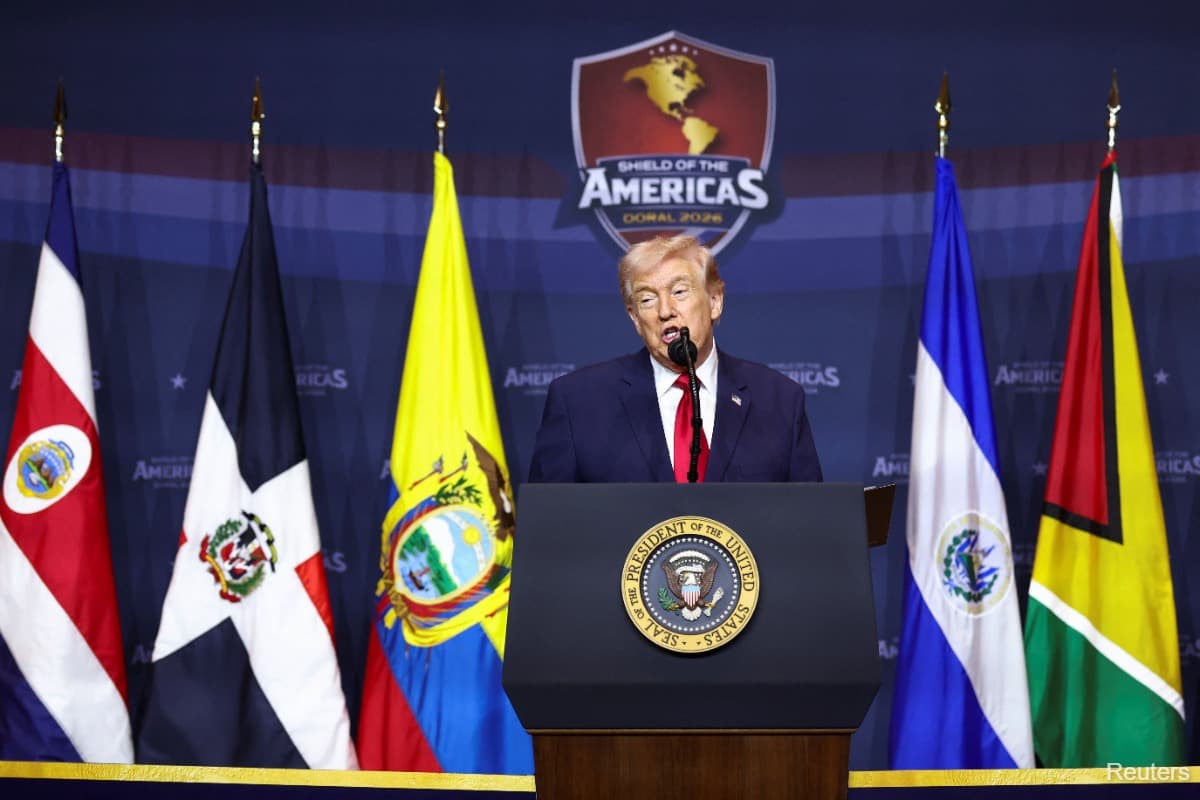

Days after ordering U.S. strikes on Iran, President Donald Trump hosted more than a dozen Latin American and Caribbean leaders at a summit in Florida to unveil a new anti-drug-cartel initiative that his administration is framing as a major hemispheric security project—while also using the gathering to sharpen warnings about China’s growing influence in the region. The meeting launched what Trump dubbed the “Shield of the Americas” coalition, a coordinated effort aimed at fighting cartel violence and transnational organized crime with a tougher, more militarized posture than many previous U.S.-backed regional approaches.
Trump’s tone combined urgency with provocation. He criticized Latin American governments for “losing control” to gangs and cartels, and he made remarks that mocked language differences—comments that underscored both his confrontational style and his tendency to use diplomacy as a stage for political messaging. At the same time, he pitched the coalition as a pragmatic security partnership, suggesting it would help countries reclaim territory and institutions from criminal groups that have become, in many places, parallel powers.
A striking element of the summit was Trump’s discussion of potential U.S. military capabilities being used against cartels. He floated the possibility of using U.S. missiles against cartel leaders—if partner governments requested it—an idea that signals how far the administration is willing to go rhetorically to emphasize deterrence and force. Even if largely symbolic at this stage, that language reinforces the coalition’s “hardline” branding and blurs the line between law enforcement cooperation and military intervention.
The guest list also reflected a political moment across the region. The presence of several right-leaning leaders and figures, including Argentina’s Javier Milei, Chile’s president-elect José Antonio Kast, and El Salvador’s Nayib Bukele, whose security crackdown has drawn both praise and criticism internationally. His broader rightward drift in parts of Latin America where public frustration with crime has boosted support for aggressive policing and “order-first” governance.
Beyond cartels, the coalition is explicitly tied to a geopolitical argument: that the Western Hemisphere should resist what Trump called “hostile foreign influence,” a veiled reference to China. The administration is positioning cartel cooperation as part of a broader contest for strategic influence—over ports, energy, telecommunications, and investment—especially as China’s economic footprint in Latin America has grown through trade and lending. Apparently, in figures of $518 billion in trade and more than $120 billion in loans to Latin American governments, which the U.S. sees as leverage that can translate into political alignment.
Overall, the Florida summit has two-track message: domestically, Trump showcases toughness on crime and borders; internationally, he signals that U.S. partnerships in the Americas will be built around security cooperation—and will increasingly be measured by where countries stand in the U.S.-China rivalry.