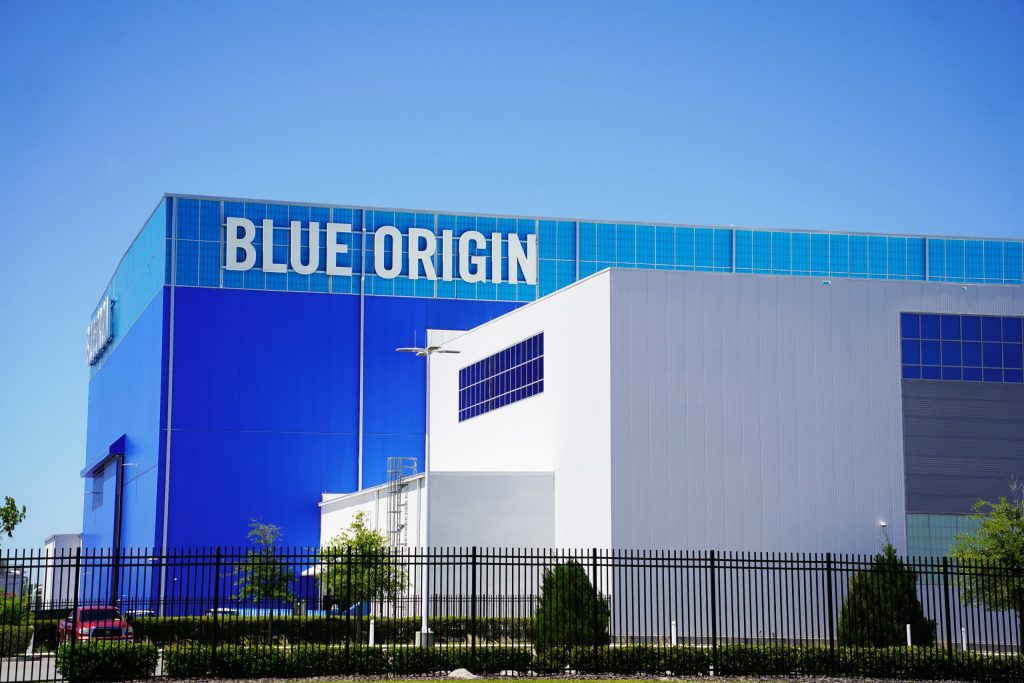

Blue Origin is expanding its presence in Florida with a new $600 million facility at its Rocket Park campus in Cape Canaveral, a move that strengthens the company’s long-term effort to compete more directly with SpaceX in the commercial space industry. Florida Governor Ron DeSantis announced the investment, framing it as another major aerospace win for the state and a sign that Blue Origin is deepening its commitment to Florida’s Space Coast.
The expansion centers on a new 830,000-square-foot upper-stage manufacturing facility. According to data, the project is expected to support about 500 aerospace jobs, with an average salary of more than $98,000. That makes the project both an industrial investment and an economic-development announcement, tying Blue Origin’s space ambitions to high-paying technical employment in Florida.
The facility is especially important because Blue Origin is trying to increase production and launch capacity for its New Glenn rocket. New Glenn is the company’s heavy-lift orbital rocket and is central to its plan to move beyond suborbital tourism and become a serious player in satellite launches, national-security missions, lunar cargo, and future deep-space operations. A larger upper-stage factory could help Blue Origin build more hardware faster, improve launch cadence, and support a growing backlog of missions.
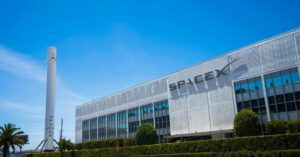
The announcement also comes as competition with SpaceX intensifies. Blue Origin’s expansion arrives while Elon Musk’s SpaceX is preparing to go public at a targeted valuation of about $1.75 trillion. That contrast matters because SpaceX already dominates the commercial launch market, while Blue Origin is still trying to prove it can launch regularly, recover boosters reliably, and scale production. The Florida facility signals that Jeff Bezos’ company is not retreating from that race; it is investing more heavily in the infrastructure needed to catch up.
Blue Origin has recently shown progress. New Glenn successfully launched NASA Mars satellites and landed its booster on an ocean barge, a milestone that pushed the company closer to SpaceX-style reusability. That mission helped demonstrate that Blue Origin could handle more serious orbital and science missions, not just passenger flights with New Shepard.
Still, the company faces a difficult road. SpaceX has built a massive lead through frequent Falcon 9 launches, Starlink deployment, reusable boosters, and continued Starship testing. Blue Origin must now prove it can manufacture New Glenn components at scale, meet mission schedules, and attract enough customers to justify its large capital spending. The new Florida facility is part of that answer: it gives the company more production capacity at the same time demand for satellite launches, lunar logistics, and national-security space services is growing.
The expansion also highlights Florida’s role as a central hub of the new space economy. Cape Canaveral and the broader Space Coast have become key locations for private launch companies, NASA partnerships, defense missions, and aerospace manufacturing. By adding another major facility there, Blue Origin is embedding itself more deeply into the region’s industrial base.
Overall, the $600 million expansion shows Blue Origin moving from ambition toward larger-scale execution. The company still trails SpaceX, but the new campus investment gives it more manufacturing power, more jobs, and a stronger foundation for New Glenn. In a space industry increasingly defined by launch speed, reusable rockets, and massive infrastructure, Blue Origin is betting that Florida will be central to its next phase of growth.