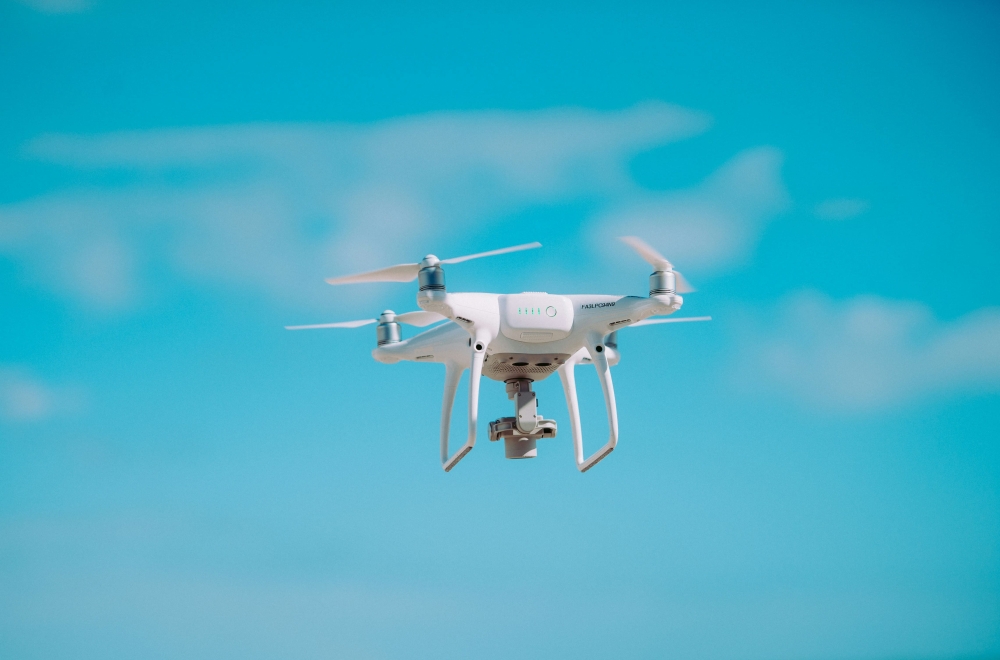

President Donald Trump has announced a sweeping new tariff regime on imported drones and their components, arguing that the United States has become dangerously dependent on foreign manufacturers for technology that is increasingly important to national security, defense and the broader economy. The measures represent another expansion of the administration’s use of trade policy to encourage domestic manufacturing and reduce reliance on overseas supply chains.
Under a presidential proclamation announced on August 13, certain drones considered particularly sensitive because of their size or capabilities will face a 100% ad valorem tariff. Smaller imported drones will be subject to a 25% tariff. The administration says the different rates are intended to focus the strongest restrictions on unmanned aircraft systems with greater national-security significance.
The policy also establishes specific rates for several important U.S. trading partners. Drones and components imported from the European Union, Japan, Liechtenstein, South Korea, Switzerland and Taiwan will face a 15% tariff, while drones imported from the United Kingdom will face a 10% tariff. The inclusion of close American allies demonstrates the administration’s willingness to apply its industrial strategy beyond its economic competition with China.
The decision follows a Commerce Department investigation led by Secretary Howard Lutnick into the national-security implications of imported unmanned aircraft systems. According to the proclamation, the investigation concluded that foreign manufacturers account for a substantial share of the U.S. drone market and that domestic production is insufficient to satisfy the country’s security requirements. Foreign-made drones and components from certain suppliers were also identified as presenting potential security and safety risks.
Drones have become increasingly important across both civilian and military sectors. They are now widely used in agriculture, construction, infrastructure inspection, emergency response, filmmaking, delivery services and law enforcement. At the same time, recent conflicts have demonstrated how inexpensive unmanned aircraft can transform military operations, surveillance and battlefield tactics. That growing strategic importance has intensified concerns in Washington about relying on foreign supply chains for drones, batteries, communications systems, sensors and other critical components.
The administration hopes the tariffs will make American manufacturing more competitive by increasing the cost of imported products and encouraging investment in domestic drone production. The strategy fits Trump’s broader effort to use tariffs as an instrument of industrial and national-security policy. However, higher import duties could also increase costs for American companies and consumers that currently depend on relatively inexpensive foreign drones or components.
Most of the new tariffs are scheduled to take effect 21 days after the proclamation. Some less-sensitive drone components will receive a longer transition period, with tariffs beginning 180 days after the proclamation. Certain products qualifying for exemptions connected to Pentagon approval and the Federal Communications Commission’s security restrictions may also receive delayed implementation.
The policy comes as the administration has pursued broader restrictions on foreign technology. The Federal Communications Commission has already taken steps targeting certain Chinese electronics, including drones, as Washington increasingly treats communications equipment and advanced technology supply chains as national-security concerns.
For the U.S. drone industry, the tariffs could create significant opportunities. Domestic manufacturers may gain greater protection from foreign competition and stronger incentives to expand production. But companies that depend on imported components could simultaneously face higher manufacturing expenses, creating uncertainty over how quickly a fully domestic supply chain can develop.
Ultimately, the new drone tariffs reflect a larger transformation in U.S. trade policy in which advanced technology, manufacturing and national security are becoming increasingly interconnected. The administration is betting that higher barriers to foreign drones will accelerate American production and reduce strategic vulnerabilities. Whether that produces a stronger domestic industry without substantially raising costs for businesses and consumers will become clearer as the tariffs take effect.