
An active-duty Air Force officer who publicly denounced President Donald Trump is facing serious military charges that could end his career, eliminate his retirement benefits and potentially send him to prison. The case of Maj. Jason Watson, a 17-year Air Force veteran, is becoming a high-profile test of how far service members—particularly commissioned officers—can go when publicly criticizing the commander in chief.
Watson faces 10 counts connected to six separate incidents, including an anonymous Substack post, two media interviews, a demonstration outside the U.S. Capitol and two alleged instances of disobeying military orders involving personal travel and uniform requirements.
The controversy began with Watson’s increasingly outspoken criticism of Trump. In an anonymous Substack post written about 14 months ago, Watson described the president using highly derogatory language, calling him, among other things, a narcissist, liar, traitor and coward. His political opposition eventually became public.
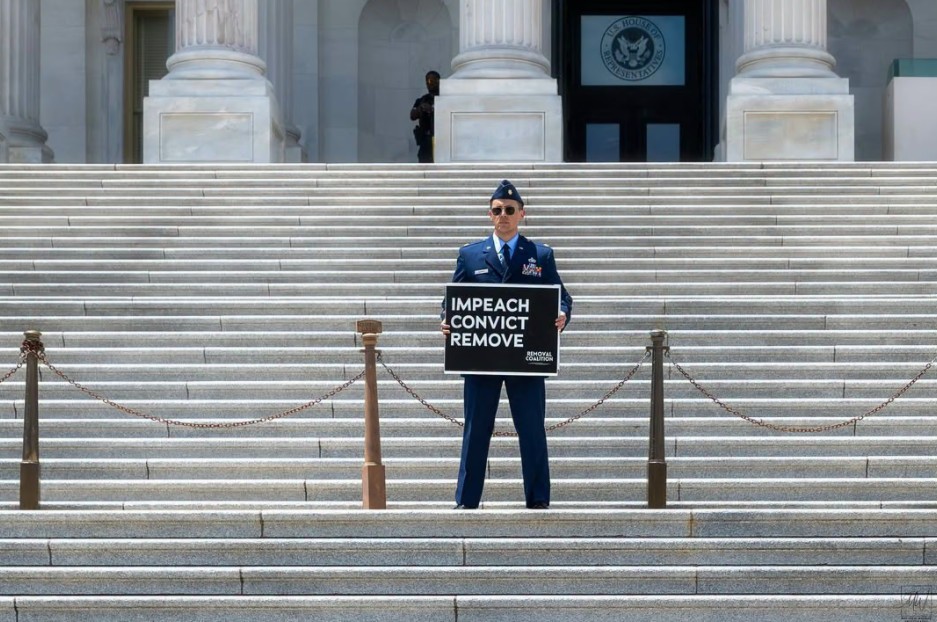
In July, Watson appeared in military uniform on the steps of the U.S. Capitol, holding a sign reading “Impeach, Convict, Remove.” He openly identified himself and acknowledged that his actions could carry serious professional consequences.
The Air Force subsequently investigated his conduct and filed charges that include allegations of using improperly “contemptuous” language about the president, dereliction of duty, disobeying orders and conduct unbecoming an officer.
Central to the case is Article 88 of the Uniform Code of Military Justice, which prohibits commissioned officers from using contemptuous words against the president, vice president and certain other government officials. The provision reflects the military’s longstanding expectation that officers maintain political neutrality and respect civilian leadership regardless of their personal political beliefs.
Military-law specialists said Watson’s conduct appears to have crossed several boundaries. Service members retain some ability to express political opinions when acting privately and outside their official roles, but appearing in uniform at a political protest and personally attacking the commander in chief can trigger substantially different military restrictions.
Watson argues that his actions were motivated by his oath to defend the Constitution rather than ordinary partisan politics. He has said meaningful opposition sometimes requires personal sacrifice and that he understood his protests could cost him his military career.
The Air Force sees the issue differently. Air Force Secretary Troy E. Meink previously said the investigation reflects concerns about behavior that could undermine the nonpartisan character of the U.S. military.
The consequences could be severe.
Military-law experts said that if Watson were convicted on every charge, he could potentially face up to 10 years in military prison. In practice, experts believe any confinement would probably be considerably shorter, potentially ranging from roughly 90 days to three years depending on the final charges and sentencing.
Even more consequential for Watson personally could be the loss of his military career and retirement benefits. After 17 years of service, he is relatively close to the 20-year point commonly associated with eligibility for military retirement. A conviction and dismissal could therefore cost him substantial lifetime benefits.
A court-martial, however, is not yet guaranteed. The charges represent allegations rather than findings of guilt. The Air Force must review the evidence and determine how the case should proceed. Watson remains in pretrial confinement while that process continues.
His attorney, Christopher Mutimer, has declined to discuss the individual charges publicly but previously emphasized that Watson understood the potential price of his protest.
The case creates an unusually stark confrontation between individual political expression and military discipline.
Members of the armed forces do not surrender all constitutional rights when they join the military. But those rights operate within a system that places extraordinary importance on discipline, command authority and the principle that America’s armed forces remain politically neutral and subordinate to elected civilian leaders.
Watson’s case will therefore have implications beyond one officer’s future. It could become an important demonstration of where the military draws the line between permissible political disagreement and conduct considered incompatible with service as a commissioned officer.
For Watson, that boundary could carry an extraordinary price: his rank, his retirement, his freedom and the conclusion of a military career that has already lasted nearly two decades.