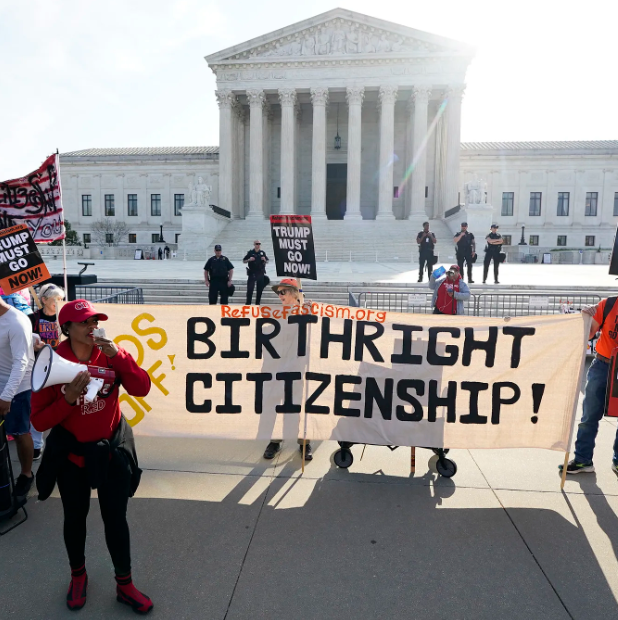

A federal judge has blocked President Donald Trump’s latest attempt to narrow birthright citizenship, dealing another legal setback to the administration after the U.S. Supreme Court rejected an earlier version of the policy in June. The ruling intensifies a constitutional battle over the meaning of the 14th Amendment and the extent of presidential authority over American citizenship.
U.S. District Judge Deborah Boardman in Greenbelt, Maryland, issued a preliminary injunction on September 2 preventing the administration from enforcing Trump’s newest executive order against children covered by an existing class-action lawsuit.
Boardman concluded that the Supreme Court had already resolved the central question for those children. In its June 30 decision in Barbara v. Trump, the Supreme Court ruled 6-3 that Trump’s original attempt to restrict birthright citizenship violated the Citizenship Clause of the 14th Amendment.
The constitutional provision, ratified in 1868, establishes citizenship for people born in the United States who are “subject to the jurisdiction” of the country. Birthright citizenship has consequently been a foundational element of U.S. citizenship law for generations.
Trump’s first executive order sought to deny automatic citizenship to children born in the United States when neither parent was an American citizen or lawful permanent resident. After the Supreme Court rejected that approach, Trump returned with a narrower executive order on August 6.
The new directive focused particularly on what the administration describes as “birth tourism”—situations in which foreign nationals allegedly travel to the United States specifically to give birth so their children receive American citizenship.
But the order went further.
It also sought to deny citizenship in certain cases involving children whose parents work for foreign governments in the United States, people accused of engaging in fraud or commercial transactions to obtain citizenship, and individuals classified by the government as “alien enemies.”
Immigrant families and advocacy organizations quickly returned to court.
The plaintiffs include CASA and the Asylum Seeker Advocacy Project, organizations that successfully challenged Trump’s original 2025 birthright-citizenship order. Their attorneys argued that families should not repeatedly have to defend citizenship rights that courts have already recognized.
Boardman agreed, concluding that the latest order was almost certainly unconstitutional when applied to members of the certified class because the Supreme Court had already determined that those children are citizens from birth.
Her injunction prevents several federal agencies—including the State Department, Department of Homeland Security and Social Security Administration—from denying, interfering with or refusing to recognize the citizenship of children protected by the lawsuit.
The ruling comes at an important moment because the administration had already begun developing procedures to implement Trump’s new policy.
The State Department drafted guidance that could require parents applying for passports for their children to provide evidence of their own citizenship or immigration status. Documents could include passports, birth certificates, permanent-resident cards or immigration records.
Justice Department lawyers argued that blocking the policy was premature because federal agencies had not yet issued final implementation guidance. They emphasized that Trump’s second order was substantially narrower than his first.
Boardman rejected that argument.
Although the administration said the policy would operate prospectively, the judge concluded that the language of the executive order could apply to children regardless of when they were born. She therefore determined that immediate judicial intervention was necessary to protect members of the class.
Importantly, the injunction does not prevent federal agencies from preparing or publishing guidance explaining how the administration intends to implement the executive order. It prevents them from using the policy to deny citizenship to the children protected by the lawsuit while the litigation continues.
The case therefore sets up another significant confrontation over presidential power and constitutional interpretation.
Trump has made restricting birthright citizenship an important part of his broader immigration agenda, arguing that existing rules are vulnerable to exploitation. His opponents counter that a president cannot redefine citizenship through executive action when the Constitution itself establishes the underlying right.
For now, the courts have again placed a barrier in front of that strategy. The latest ruling reinforces the principle that changes to birthright citizenship cannot simply be imposed through presidential orders when they conflict with constitutional protections already recognized by the Supreme Court.
The legal battle is unlikely to end here. But after two executive orders and repeated litigation, Trump’s campaign to redefine who automatically becomes an American citizen at birth continues to face formidable constitutional obstacles.