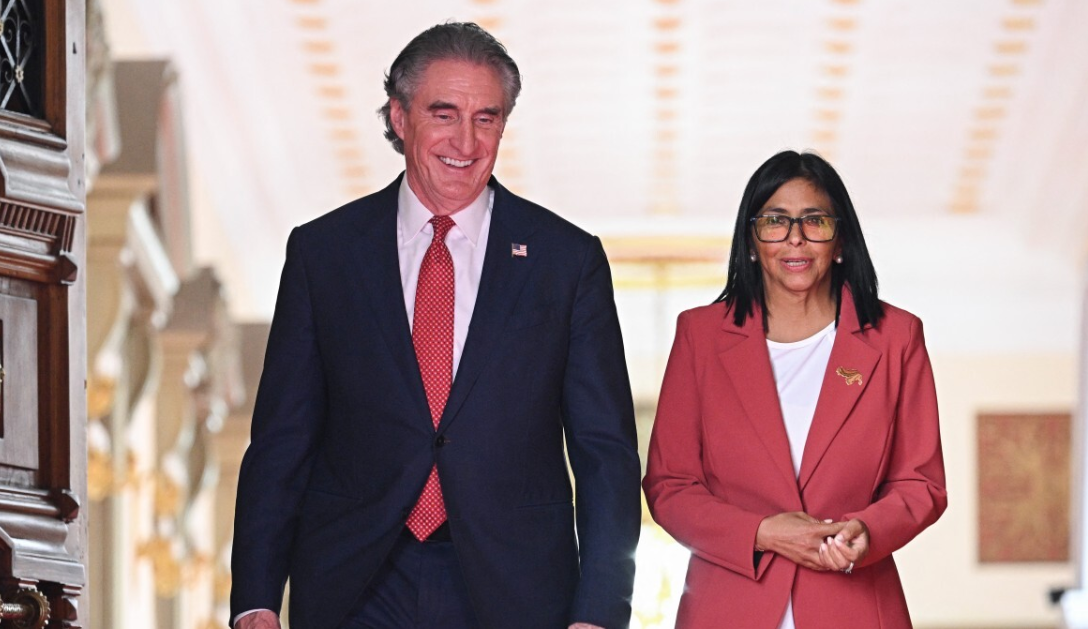

Trump´s administration is privately escalating pressure on Venezuela’s interim president, Delcy Rodríguez, by preparing a draft U.S. criminal indictment that could charge her with corruption and money laundering—an approach aimed less at immediate prosecution than at increasing Washington’s leverage over Caracas. Four people familiar with the matter said that federal prosecutors have assembled potential charges and that U.S. officials have conveyed to Rodríguez that she could face prosecution if she does not continue complying with U.S. demands following the January capture of former Venezuelan leader Nicolás Maduro.
The draft indictment is reportedly being prepared by the U.S. Attorney’s Office in Miami, and sources said it has been evolving over roughly two months. The investigation focuses on alleged laundering of funds linked to Venezuela’s state oil company PDVSA, with the reported time window covering activities between 2021 and 2025. She had been made aware of it verbally.
The legal threat sits alongside other forms of pressure. U.S. officials have presented Rodríguez with a list of at least seven former senior party officials and associates—and family members—whom Washington wants arrested or kept in custody for possible extradition. This is framed as part of a broader strategy to influence the post-Maduro government and to demonstrate that cooperation with the U.S. has consequences for former regime insiders.
The story underscores a sharp contrast between public diplomacy and private coercion. Trump has publicly praised Rodríguez for cooperating with the United States and described Venezuela as a “friend and partner,” including in his State of the Union remarks. Yet the indictment threat is portrayed as a bargaining chip meant to compel actions behind the scenes—suggesting Washington is simultaneously courting Rodríguez as a stabilizing figure while warning her that she could become the next target.
The report places all of this within the unusual political landscape created by Maduro’s removal. Since the January raid that brought Maduro to the U.S. for trial, Trump has relied on Rodríguez—formerly Maduro’s vice president—to maintain stability while the U.S. prioritizes access to Venezuelan oil resources. Several other figures still serving in the interim government have already been indicted in the United States, including Interior Minister Diosdado Cabello and Defense Minister Vladimir Padrino, who have denied wrongdoing.
A key name highlighted is Alex Saab, a prominent Maduro-linked financial operator. Saab was arrested in early February and remains detained by Venezuela’s intelligence service SEBIN, and that the U.S. has a new sealed money-laundering indictment against him, according to two sources. If extradited, Saab could potentially provide information that would strengthen U.S. cases against Maduro, though extradition can be complicated because Venezuelan law bars extraditing Venezuelan nationals.
Preparing a draft indictment does not guarantee prosecutors will present it to a grand jury, and it was not clear whether any evidence had yet been presented. Still, the existence of a developing draft—and its use as leverage—signals a hard-nosed U.S. strategy: keep Venezuela’s interim leadership cooperative by pairing public partnership language with the implicit threat of U.S. prosecution.